Wide-Angle Photography
Wide-angle photography is one of the most demanding disciplines underwater. Behind a dome port, even an excellent lens can produce soft corners, and the reason is usually not the lens itself but how lens and dome work together. This page first explains the basics in a few short sections, then describes the dome port planner, and finally summarizes my measurements of four lenses and five domes.
1. How a dome port works
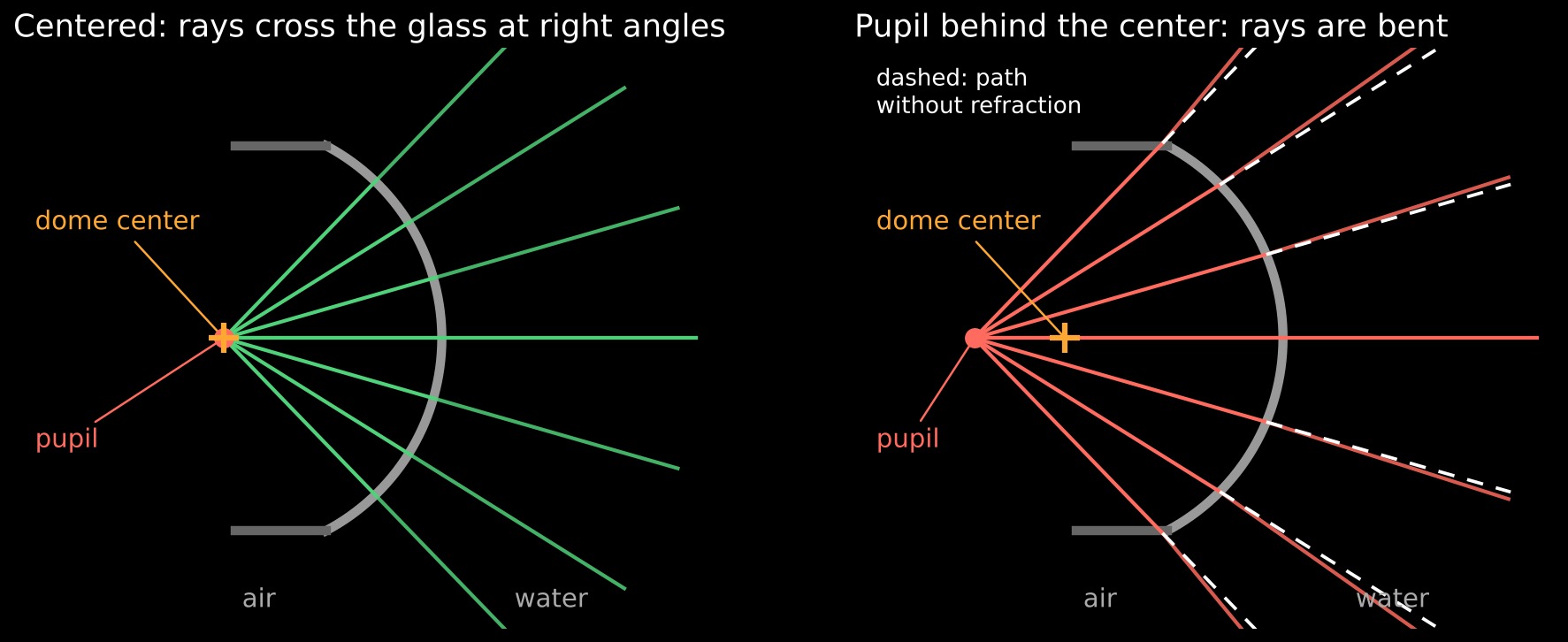
Why a dome? Behind a flat port, refraction at the glass narrows the angle of view considerably and blurs and distorts the edges of the image. A dome avoids this, provided its center sits at the entrance pupil of the lens: every ray then crosses the glass at a right angle and is not bent, so the lens keeps its full angle of view (Figure 2 shows what happens otherwise).
The virtual image. Underwater, the lens does not focus on the subject itself but on a virtual image formed by the dome. Everything from the glass to infinity appears squeezed into a narrow zone in front of the dome: a subject touching the glass appears at the glass, a subject at infinity about three dome radii in front of it. For a dome with a radius of 7 cm, that is only about 20 cm.
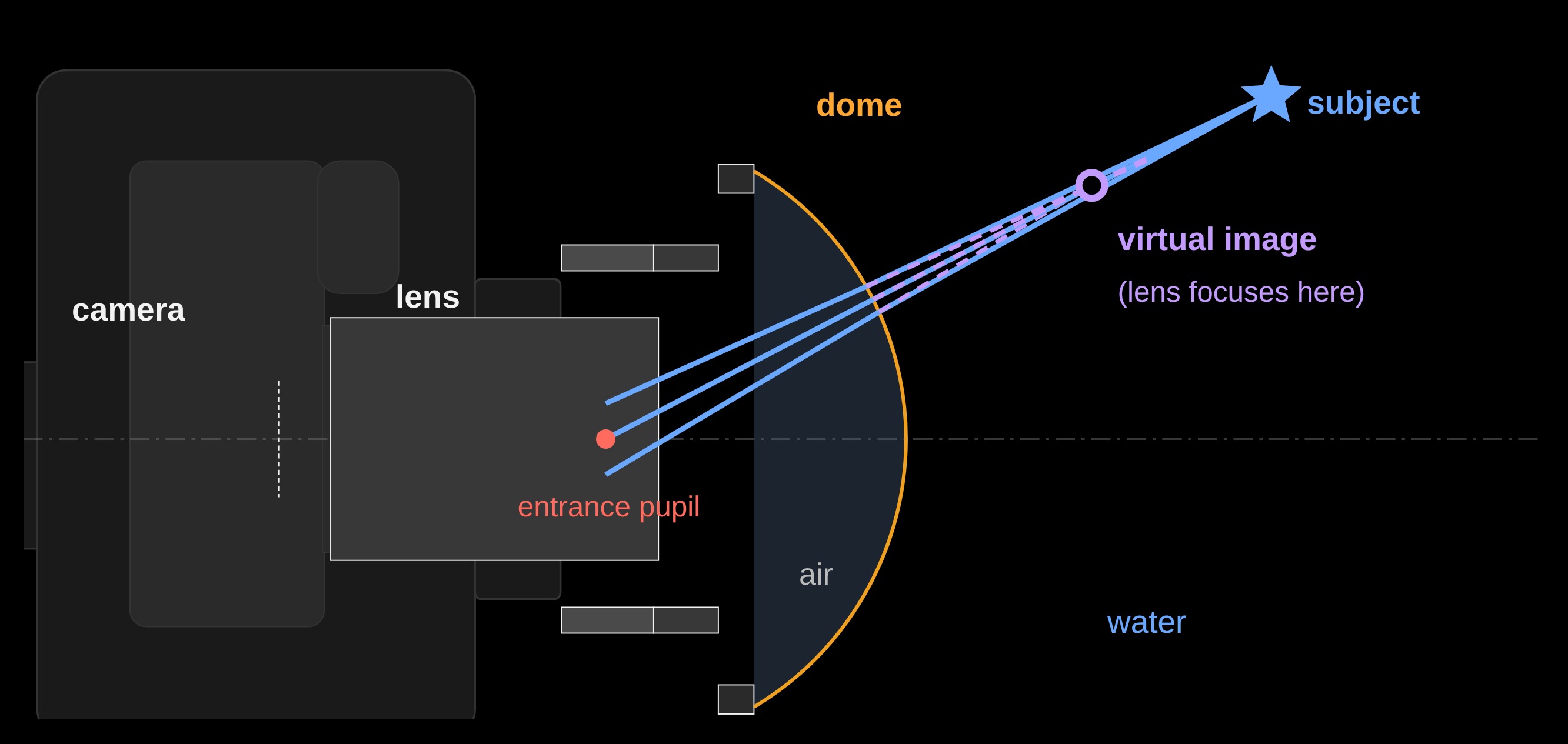
Two consequences follow. The lens must be able to focus very close, otherwise subjects near the dome cannot be made sharp. And a small dome brings the virtual image closer, which is good for close-focus wide-angle shots, while a large dome pushes it farther away.
Centering the dome. The dome works best when its center of curvature sits on the lens's entrance pupil, the point from which the lens "sees" the scene. Then all rays cross the glass at right angles. If the pupil sits in front of or behind the center, the rays at the edge of the image are bent, and the corners become soft and show color fringes. The position is set with extension rings between housing and dome, and a few millimeters matter.
How much does decentering cost? Water bends blue light slightly more than red. When the rays cross the glass at an angle, the colors therefore leave the dome in slightly different directions, and every edge in the corners gets a blue and a red fringe. I calculated this by tracing rays for the Sea&Sea 170AR and the Z 17–28 at 17 mm. With the dome centered there is no fringe at all. With the entrance pupil 20 mm behind the center (rings too long), the fringe in the frame corner is about 5 pixels wide on the Z8; with the pupil 20 mm in front of the center (rings too short), about 8 pixels. That is more than the diffraction blur at f/11. Blurring from the decentering itself (astigmatism) stays below half a pixel at f/11 and is negligible by comparison.
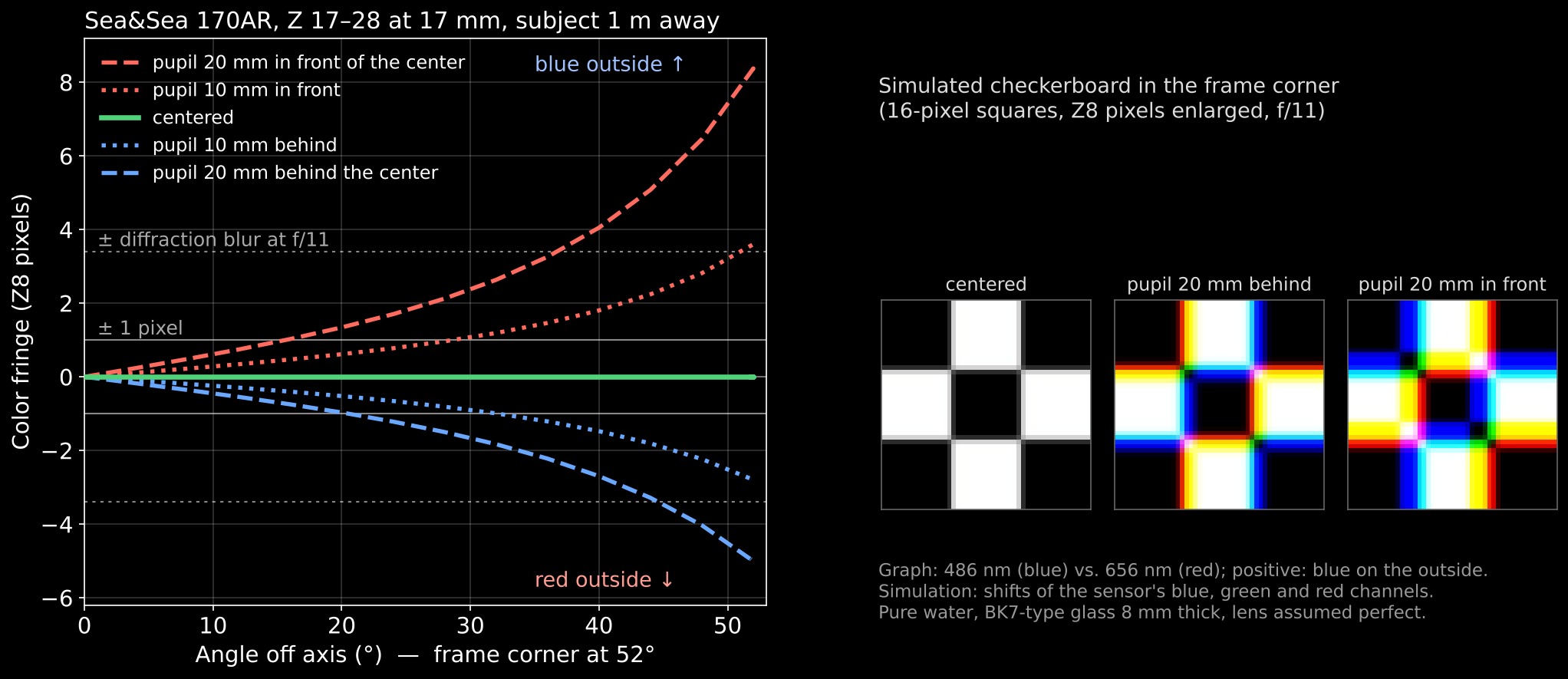
Can software fix it? Only partly. Raw converters ("Remove chromatic aberration" in Lightroom) shift the red and blue channels back into register, and the colored edges disappear. But each color channel of the sensor covers a whole band of wavelengths, and within each band the colors are still spread out. That spread remains as softness: for the 170AR without an extension ring, the green channel alone is smeared over about 2.5 px in the corners, half the original fringe. Only a centered dome avoids both the fringe and the smear.
Checked in the pool. With the 170AR and the Z 17–28 at 17 mm, the corner fringe was 6–8 px without an extension ring and about 2.5 px with a 21.5 mm ring. The Z8 removes the lens's own color fringe in its JPEGs, but not the one from the dome, so the JPEGs show the dome's share directly (section 5).
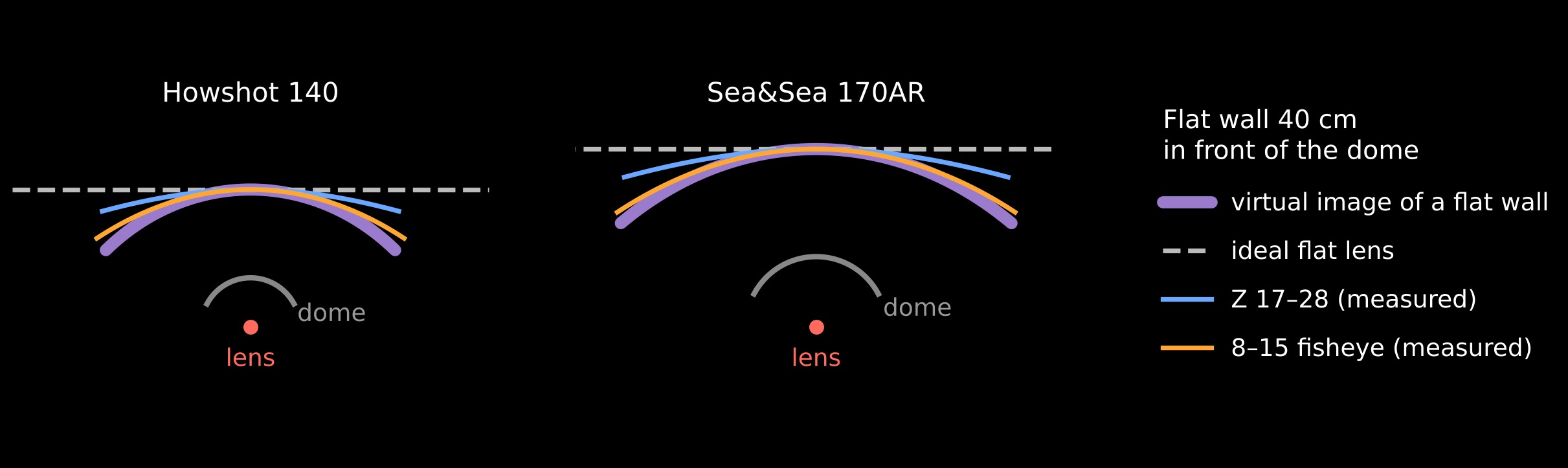
Curved image, curved sharpness. The virtual image of a flat wall is not flat but curved toward the camera. A lens whose own zone of sharpness curves the same way (most fisheyes and many wide-angle zooms do, to some degree) compensates for part of it. A lens that curves the other way makes things worse. What remains has to be covered by depth of field, that is, by stopping down.
Aperture. Stopping down increases depth of field but also adds diffraction blur, which affects every lens equally and depends only on the aperture:
Table 1. Diffraction blur on the Z8 sensor.
| Aperture | Diffraction blur (Z8 pixels) |
|---|---|
| f/8 | 2.5 px |
| f/11 | 3.4 px |
| f/13 | 4.0 px |
| f/16 | 4.9 px |
| f/22 | 6.8 px |
A perfectly focused edge spans about 2 px on the Z8. From f/11 on, diffraction dominates, and every further stop costs sharpness in the whole image. In practice: f/8 where the depth of field allows it, f/11–f/13 as standard, f/16 only when necessary, f/22 never.
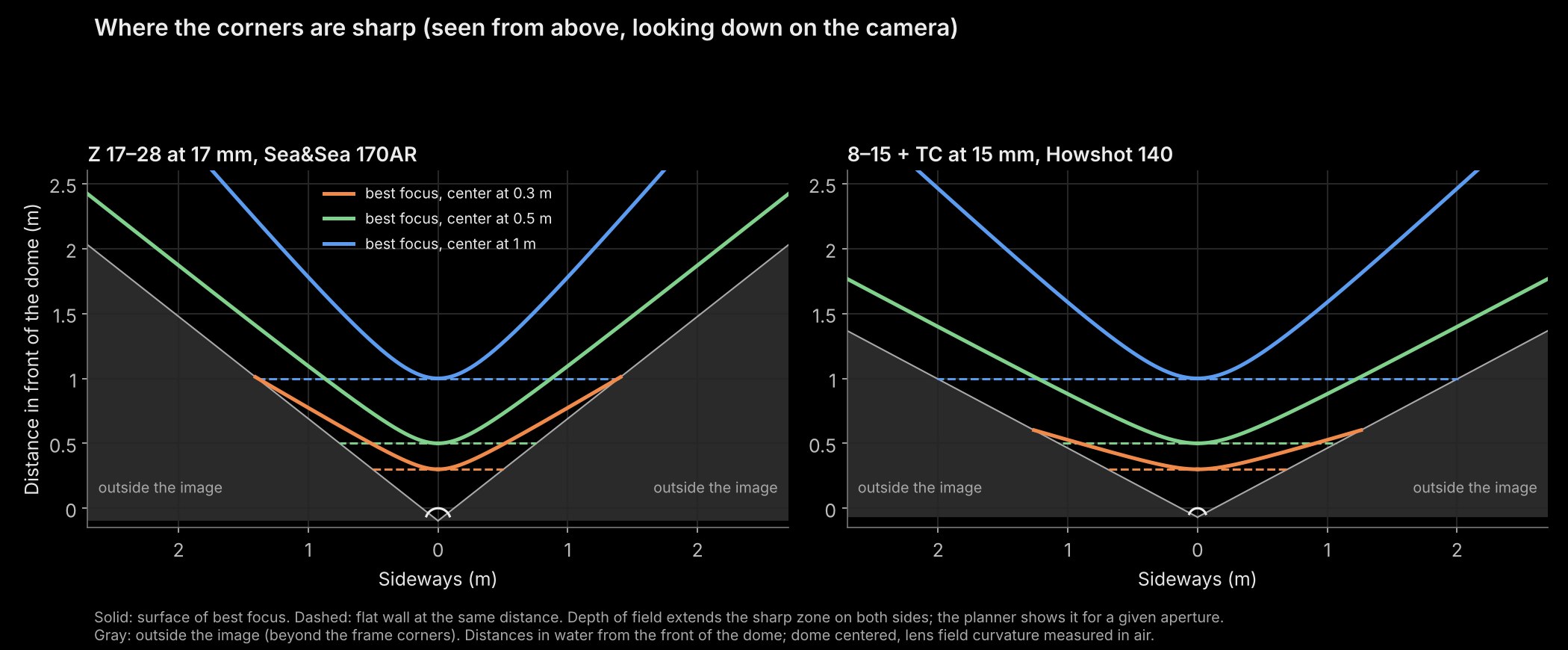
What about corner sharpness? It depends less on the lens than on how the dome is set up and what is in the corners. Behind a dome the virtual image curves toward the camera, so with the focus on the main subject, the corners are sharpest for things farther away than a flat wall (Figure 5). A flat test wall therefore shows soft corners, while reef that recedes toward the edges, a coral head curving away or open water fall into the sharp zone. Difficult are foreground close to the dome in the corners and concave scenes such as caves; there only stopping down helps. Corners that are sharp at some distance look natural. Corners where nothing is sharp at any distance come from a dome that is not centered, a dome that is too small, or an aperture that is too wide. Where to focus: behind the 170AR with the 17–28 at 17 mm, everything from 0.3 m in front of the glass to infinity fits into the depth of field at f/11 (standard circle of confusion), provided the focus sits in the middle of this range, at about 0.7 m. The familiar rule of one third of the depth of field in front of the focus point and two thirds behind it does not apply here; behind a dome nearly all of it lies behind the focus point. For scenes that recede toward the background, focusing a little behind the main subject therefore gives the best overall sharpness; with close foreground in the corners, focus on the subject or slightly in front of it.
2. Choosing the lens
For underwater wide angle, three properties matter more than sharpness on a test chart:
- Angle of view. A fisheye covers 180° diagonally and is the easiest lens behind a dome, because its own field curvature matches the dome well. A rectilinear wide-angle lens keeps straight lines straight, which matters for wrecks, divers and anything man-made, but it is far more demanding on the dome.
- Close focus. The lens has to focus on the virtual image close to the dome. The closer it focuses, the larger a small subject in front of the dome can be.
- Position of the entrance pupil. It decides which extension rings are needed, and whether a dome can be centered at all. For zooms it moves when zooming, so the dome can only be centered perfectly at one focal length.
A teleconverter behind a fisheye zoom (here a Kenko 1.4×) is an interesting option: the Nikon 8–15 becomes an 11–21 mm fisheye zoom that fills the frame over its whole range and gives a third more magnification for close subjects. In my tests it cost no measurable sharpness at f/5.6; the real price is one stop of light and a longer lens.
3. The dome port planner
The dome port planner puts these relations into numbers. You choose housing, dome, lens, focal length and extension rings, and it draws the setup to scale and shows:
- how far the dome's center lies from the entrance pupil, and which ring combination comes closest,
- whether the dome rim (or an inner tube of the port) cuts into the corners of the image ("Vignetting" in the results, and dashed corner rays in the drawing),
- where the virtual image lies and how close you can get to a subject,
- how much of a flat wall is sharp at a given aperture, including the lens's own field curvature.
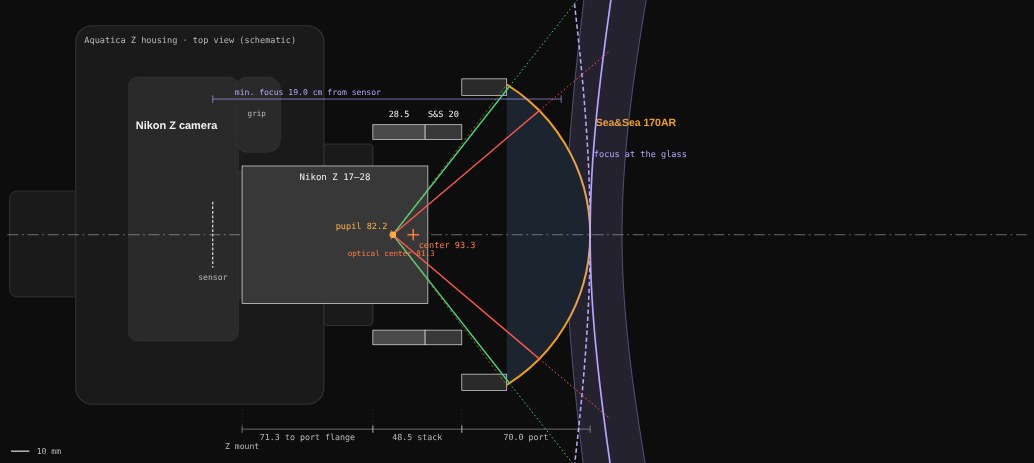
The planner is only as good as its data, so I measured as much as I could myself:
- Housing: the port flange of the Aquatica AZ8 sits 71.3 mm in front of the Z mount. For Nauticam housings, the data were measured by Dave Hicks.
- Domes: radius and position of the glass from side photos with a ruler, for my own domes partly checked with a caliper (about ±1–3 mm).
- Entrance pupils: with a pin-and-ruler parallax method on a nodal rail, for every lens and several focal lengths, at close focus.
- Close range: behind a dome a lens always focuses on the virtual image, about 25–50 cm from the sensor, never at infinity. All measurements in air were made at these short distances. Pupil position and field curvature change with the focus distance, so published data measured at infinity, such as field curvature tests for astrophotography, do not apply behind a dome.
- Field curvature: from focus series of a test chart at different angles, at close range (section 4).
- Checks: vignetting and sharpness tests in air and in the pool, and centering checked in the pool from the color fringe in the corners. Where the pool result differs from the geometry, as for the 170AR, the planner uses the measured optical center.
The results are a reliable starting point, not a replacement for a test dive.
4. The four lenses
I tested the four Nikon Z-mount options that are relevant for wide angle on the Z8: the Z 14–30 f/4, the Z 17–28 f/2.8, the Z 20 f/1.8 and the Nikon 8–15 fisheye on the FTZ adapter, with and without the Kenko 1.4× teleconverter.
Table 2. The four lenses.
| Lens | Angle of view | Closest focus (from the sensor) | Max. magnification (in air, at closest focus) | Entrance pupil (in front of the Z mount) |
|---|---|---|---|---|
| Z 14–30 f/4 | 114° (14 mm) – 72° (30 mm) | 28 cm | 0.16 | 90 mm (14 mm) – 81 mm (30 mm) |
| Z 17–28 f/2.8 | 104° (17 mm) – 75° (28 mm) | 19–26 cm | 0.19–0.17 | 82 mm (17 mm) – 77 mm (28 mm) |
| Z 20 f/1.8 | 94° | 20 cm | 0.19 | 79 mm |
| Fisheye 8–15 | 180° circular image (8 mm) – 175° diagonal (15 mm) | 16 cm | 0.17–0.34 | 98–104 mm |
| Fisheye 8–15 + 1.4× TC | 170° (11 mm) – 125° (15 mm) | 18 cm | 0.33–0.49 | 119–123 mm |
Angles of view are diagonal unless stated otherwise; for the fisheye with TC the focal lengths are those set on the zoom ring. Closest focus and magnification refer to the bare lens in air. Behind a dome the lens focuses on the virtual image, so both change; the planner shows for each combination how close a subject can come to the dome.
Field curvature. I measured the shape of the sharp zone with focus series of a test chart at 0° to ±50° off axis. A value of 0 means a flat sharp plane, 1 a sphere around the lens; positive values curve toward the camera, which helps behind a dome.
Table 3. Field curvature measured at close range (0 = flat field, 1 = sphere around the lens).
| Lens | Field curvature | Behind a dome |
|---|---|---|
| Fisheye 8–15 | about +0.65 (+0.5 with TC) | very favorable |
| Z 17–28 | +0.14 (17 mm) to +0.4 (24 mm) | favorable |
| Z 20 f/1.8 | +0.13 | favorable |
| Z 14–30 at 20–30 mm | 0 to +0.3 | neutral to favorable |
| Z 14–30 at 14 mm | down to −0.7 | unfavorable |
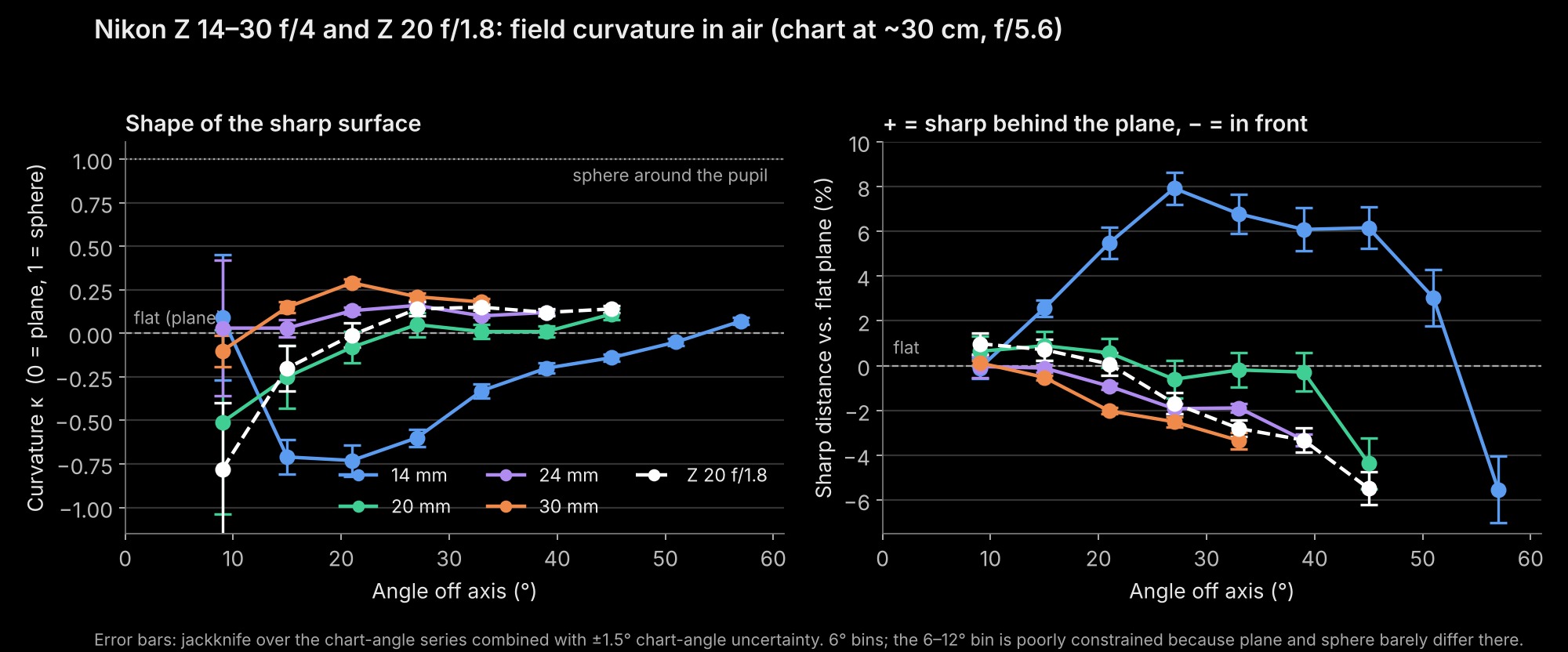
Nikon Z 14–30 f/4. The widest rectilinear lens, but the least suited for a dome. At 14 mm its sharp zone curves away from the camera in the middle of the field, exactly opposite to the dome's virtual image, and it focuses only to 28 cm. From 20 mm on it behaves well, but there the Z 17–28 does the same job with closer focus. I do not use it underwater.
Nikon Z 17–28 f/2.8. My rectilinear lens for underwater: it focuses closest, its field curves gently toward the camera at all focal lengths, and its entrance pupil moves only 6 mm when zooming, so one ring setting fits the whole range. In the Sea&Sea 170AR its corners at best focus are only 1–2 pixels softer than the center; at 28 mm and f/11 they are as sharp as the center. f/8–f/13 work well (section 5).
Nikon Z 20 f/1.8. Optically very similar behind a dome to the 17–28 at 20 mm, with slightly more favorable curvature at the edges. Without zoom it is less versatile, so I measured it only for the planner.
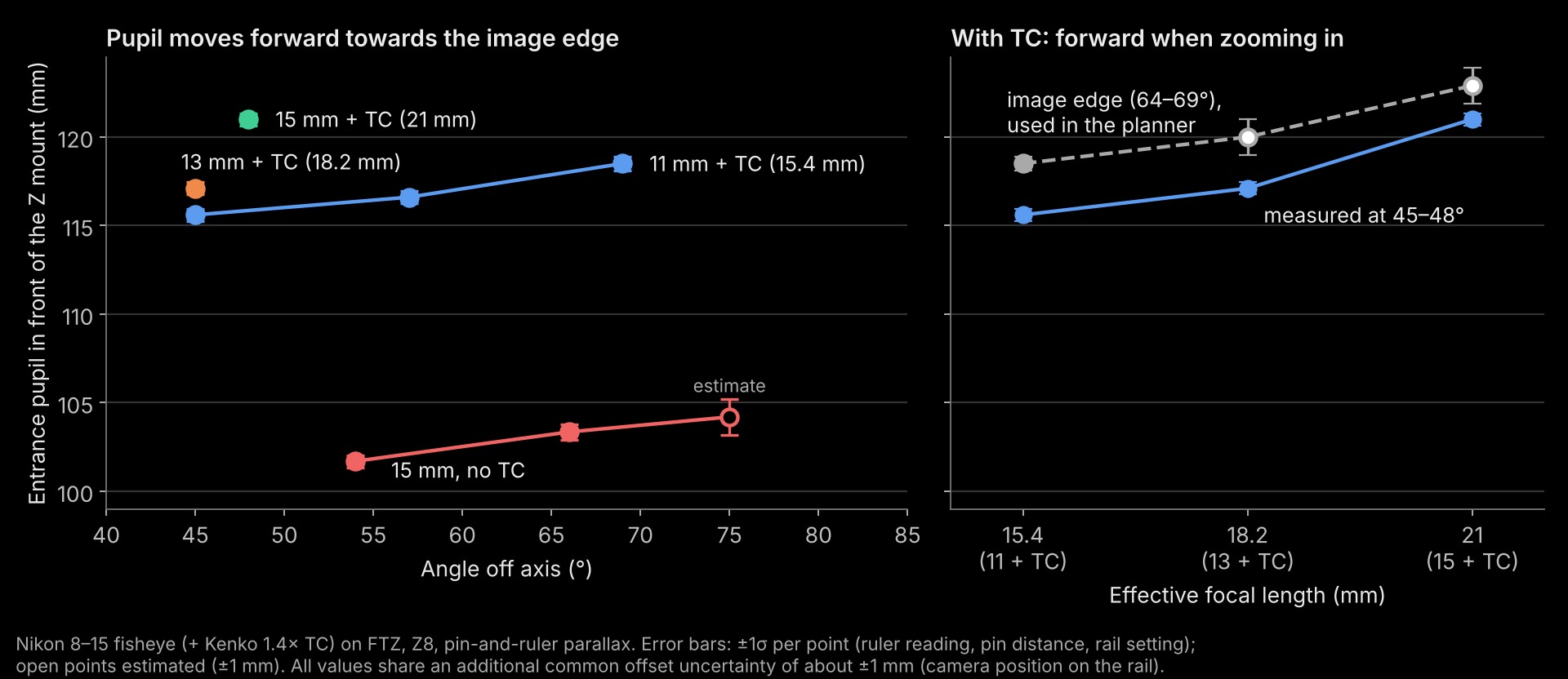
Nikon 8–15 fisheye (+ TC). The easiest lens behind a dome and the one with the highest magnification. Its entrance pupil moves forward toward the edge of the image and when zooming in (Figure 8). With the teleconverter, the whole lens and its entrance pupil sit about 2 cm farther forward, so the dome has to move forward too, which needs about 2 cm longer rings. Below about 10.5–11 mm on the zoom ring, the teleconverter's image circle no longer fills the frame and the corners turn black, whatever the dome.
5. The five domes
Over the years I have collected five domes, three of them from the time of my DX cameras. Figure 10 shows them to scale, mounted on the Aquatica housing.
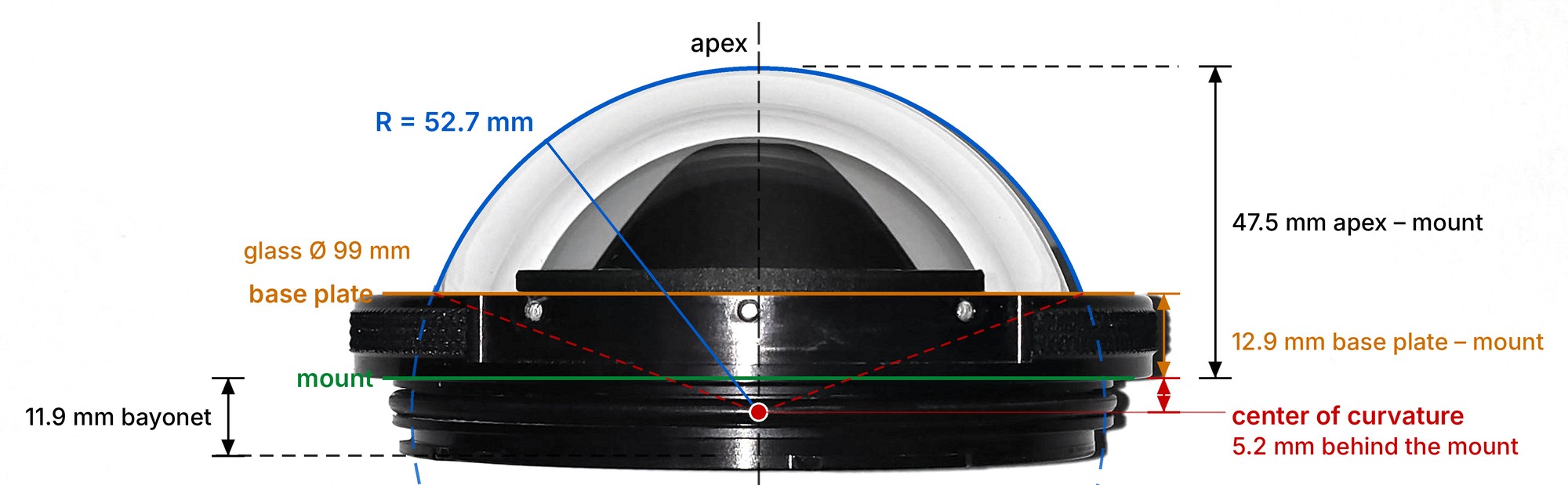
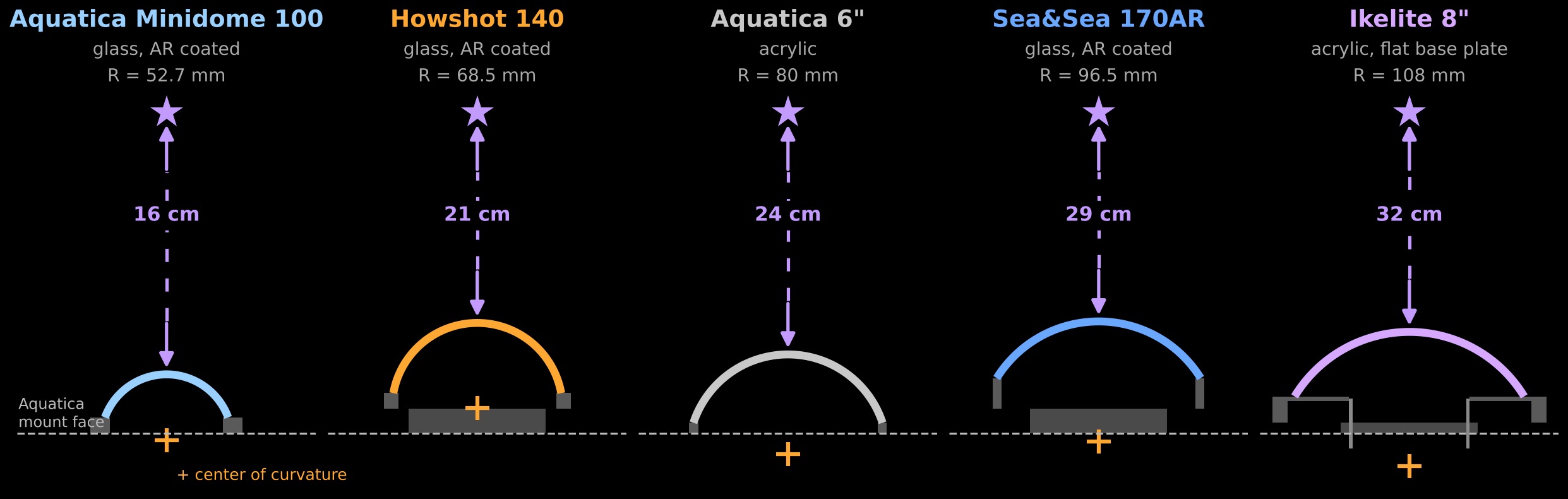
Table 4. The five domes and, in gray, the other domes in the planner. Visible glass height: from the edge of the frame, where the glass emerges, to the front of the dome. Max. angle of view from the center: the full angle between opposite edges of the frame, seen from the dome center; a lens centered in the dome cannot see more than this, and one whose entrance pupil sits in front of the center sees a little more. For comparison: the Z 17–28 at 17 mm covers 104° diagonally, the 8–15 + TC 125° (15 mm) to 170° (11 mm).
| Dome | Radius | Visible glass height |
Max. angle of view from the center |
Material | Infinity appears at |
Used with |
|---|---|---|---|---|---|---|
| Aquatica 100 (#18411) | 53 mm | 35 mm | 140° | glass, AR coated | 16 cm | 8–15 + TC (borderline) |
| Howshot 140 | 69 mm | 56 mm | 160° | glass, AR coated | 21 cm | 8–15 + TC |
| Nauticam 140* | 69 mm | 55 mm | 157° | glass, AR coated | 21 cm | not tested by me |
| Aquatica 6" (#18409) | 80 mm | 55 mm | 143° | acrylic | 24 cm | 8–15, Z 17–28 |
| Sea&Sea 170AR | 97 mm | 46 mm | 116° | glass, AR coated | 29 cm | Z 17–28 |
| Zen DP-170* | 100 mm | 41 mm | 107° | glass, AR coated | 30 cm | not tested by me |
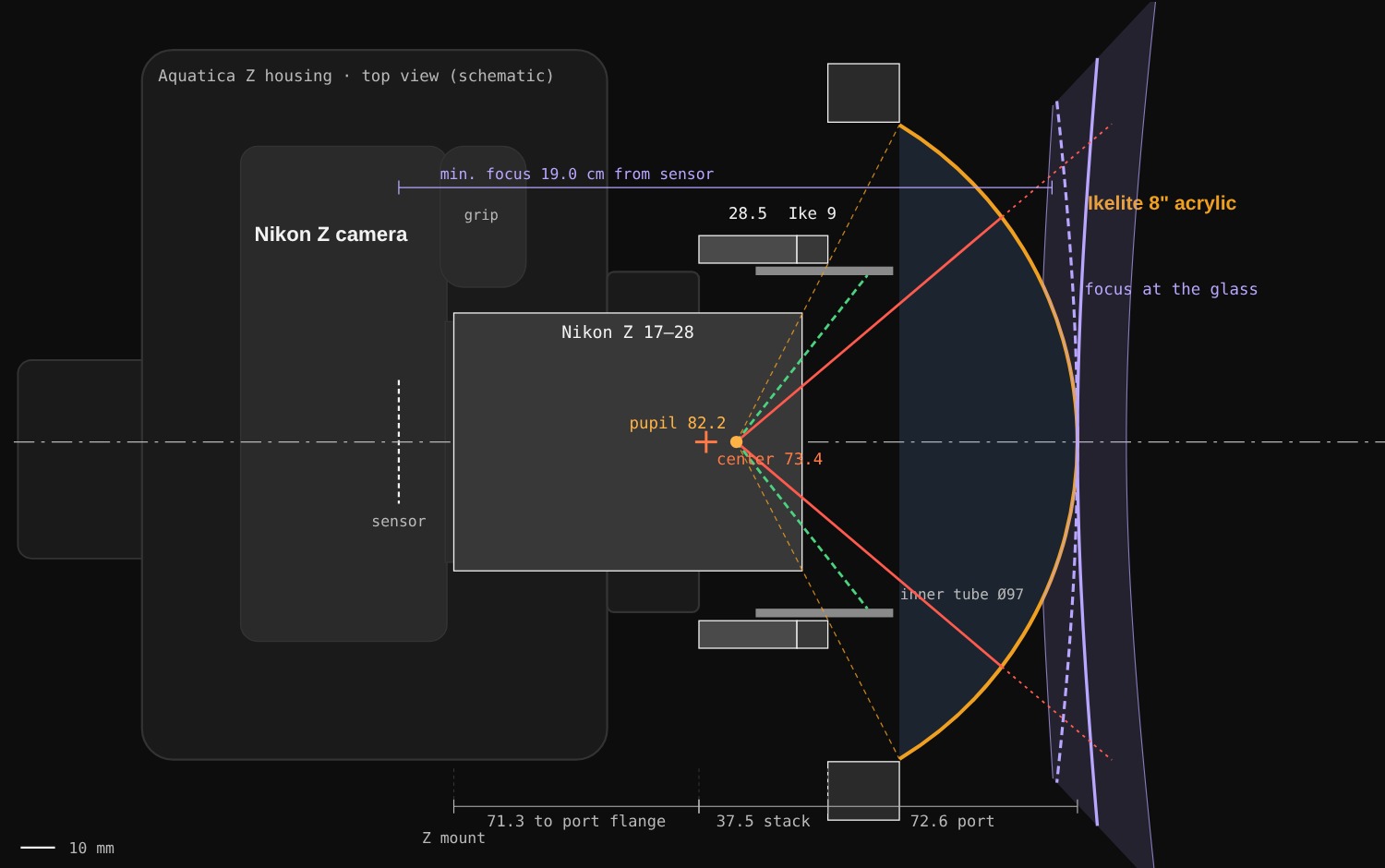
| Ikelite 8" (#5510.45) | 108 mm | 52 mm | 117° | acrylic | 32 cm | Z 17–28 (24–28 mm only) |
| Nauticam 8.5"* | 118 mm | 69 mm | 131° | acrylic | 35 cm | not tested by me |
* Gray: domes from the planner with data from other sources (published values and photos by other photographers), not measured by me.
The glass domes carry an anti-reflection coating on the inside only. The outside is in contact with water and has to survive sand, rocking boats and waves; a coating there would soon be scratched.
Aquatica Minidome 100. A small coated glass dome, light and with the closest virtual image. On full frame, however, it is too small: even with the 8–15 + TC it is borderline (with a 39.5 mm ring, usable from 11 to 15 mm), and for rectilinear lenses it is far off.
Howshot 140. A compact coated glass dome and my standard dome for the 8–15 + TC. Its glass starts 32 mm in front of the Aquatica mount face (20 mm adapter plus 12 mm port base). With a 21.5 mm ring there is no vignetting from 10.5–11 mm on the zoom ring; with 28.5 mm the corners clear only from 12 mm. The longer ring would center the dome slightly better, but the shorter one gives the full zoom range; the pool test agrees. The shade adds no vignetting. In the pool, the color fringe stayed below 1 pixel at 11–15 mm, as small as the geometry predicts: this dome is centered where its shape says it should be.
Aquatica 6" acrylic. A light, inexpensive middle option. With the Z 17–28 and a 28.5 mm ring it gave a very good visual test without vignetting, and with the 8–15 + TC and 56 mm of rings it is usable from 13 to 15 mm. Acrylic scratches easily, but scratches can be polished out.
Sea&Sea 170AR. A compact coated glass dome and my dome for the Z 17–28. It is the smallest dome in which the 17–28 can still focus on a subject right at the glass, and that makes it an excellent travel dome. Many divers use 8–9" domes, which are much bigger, heavier and more expensive. With the Sea&Sea adapter and a 28.5 mm ring it worked very well in Cayman, without vignetting at 17 mm. Its construction is unusual: the back plate slopes backward toward the center, so the glass starts 24.5 mm in front of the Sea&Sea mount face, much farther than the outer edge of the port suggests. From its shape, the dome center would sit on the entrance pupil with a 16.5 mm ring; the pool tests put the optical center about 12 mm farther back, which makes the 28.5 mm ring the right choice.
Pool tests. Adapter alone and 21.5 mm ring, 17 and 28 mm, f/5.6–f/11, tiled wall at 50 and 100 cm, focus-shift series.
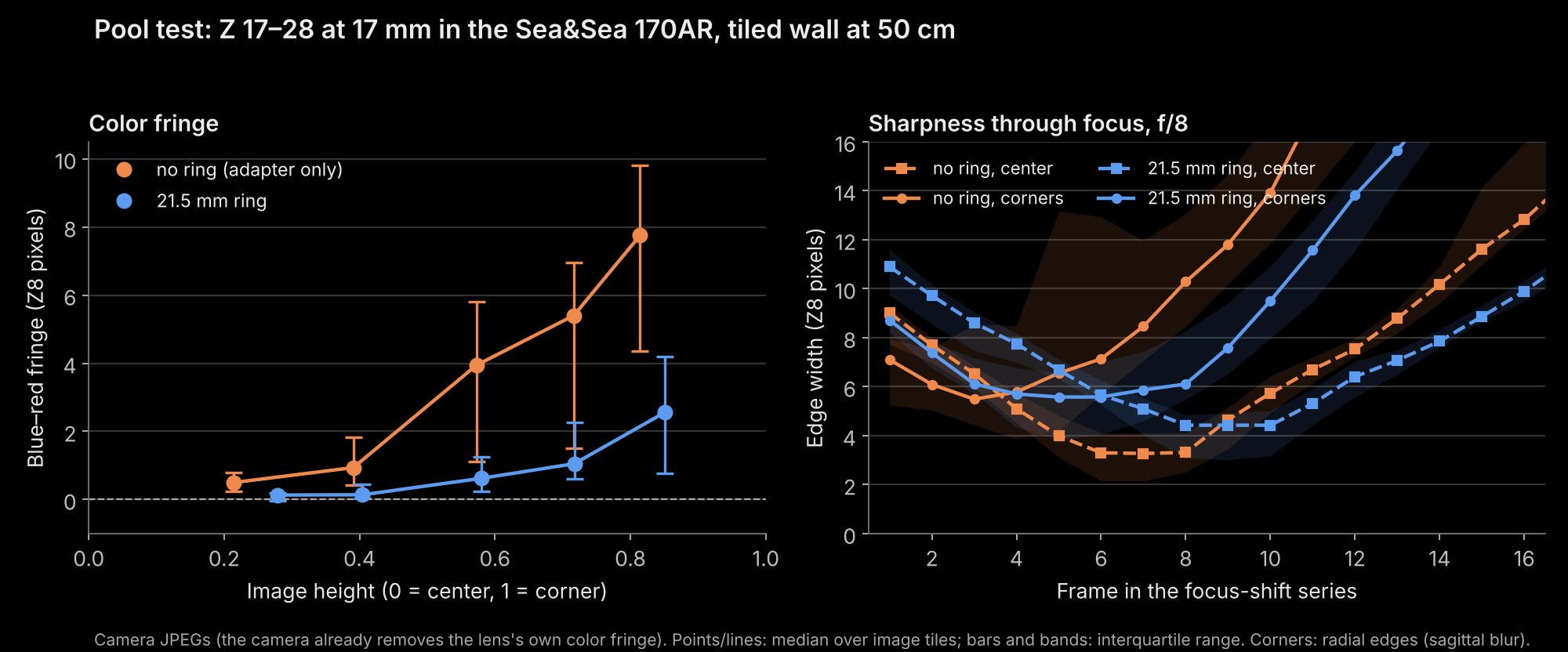
Table 5. Color fringe in the corners of the Sea&Sea 170AR with the Z 17–28 (pool test).
| Color fringe in the corners | 17 mm | 28 mm |
|---|---|---|
| Adapter only | 6–8 px | about 4 px |
| 21.5 mm ring | about 2.5 px | 1–1.5 px |
- Color fringes: the ring reduces the fringe, but blue stays on the outside of every edge, although by the geometry the colors should already swap with the 21.5 mm ring. All seven series together put the optical center 12 ± 5 mm farther back than the shape of the dome suggests (Figure 12). Radius, vertex height and entrance pupil were re-measured and agree, and the Howshot 140, tested the same way, matches its geometry. The cause is still open, possibly glass that is not exactly concentric; more tests are needed. The planner uses the measured optical center for this dome.
- Sharpness: at best focus the corners are 1–2 px softer than the center at 17 mm, and as sharp as the center at 28 mm and f/11. At f/8–f/11 one focus setting serves center and corners; at f/5.6 the focus has to be set between them. In an aperture series the middle of the field was sharpest at f/13.
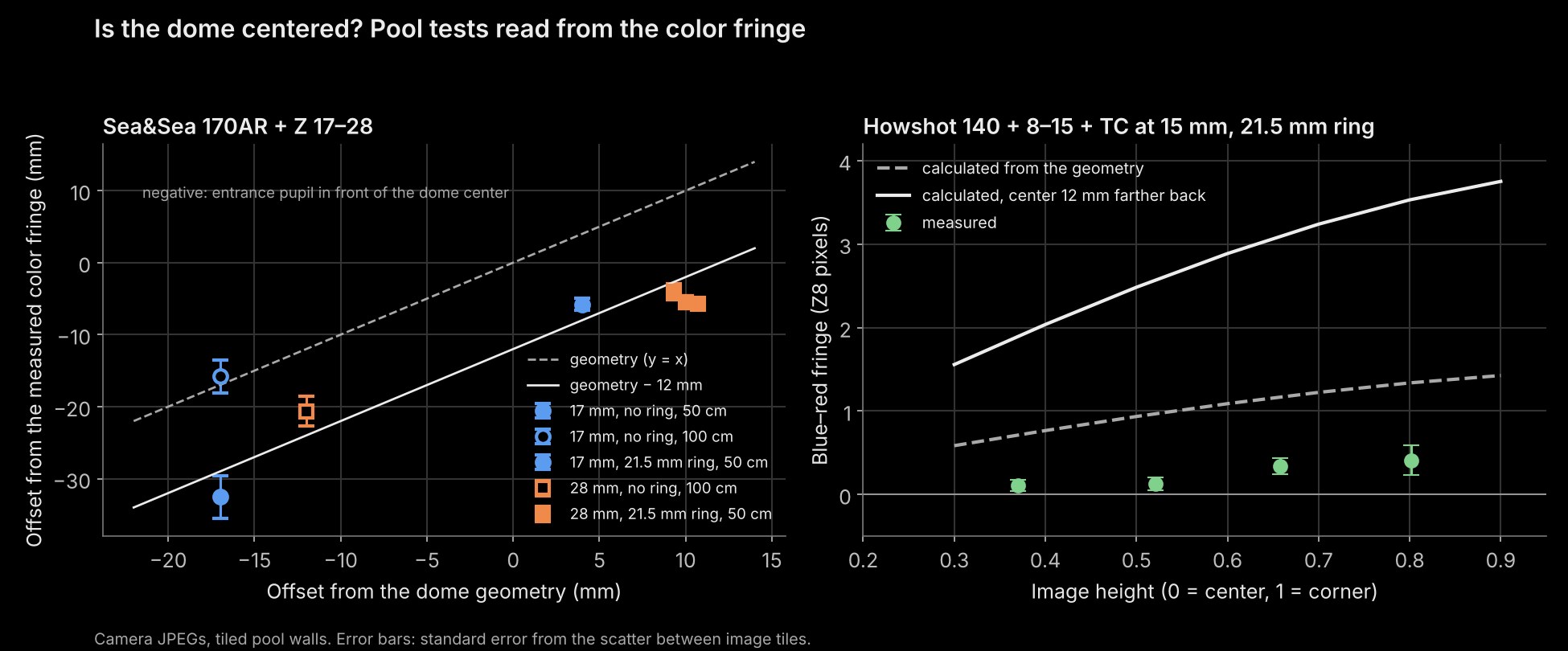
The tile edges limit the resolution to about 1 px; the next tests will use printed targets and the 28.5 mm ring.
Ikelite 8" acrylic. The largest radius, but designed for DX cameras, before full frame became mainstream underwater. The dome sits on a flat base plate with an inner tube of 97 mm diameter. This tube is no problem for DX, but with a full-frame lens it cuts into the corners at short focal lengths. With the Z 17–28 it can be used only from 24 mm. With its adapter it is also much bigger and heavier than the 170AR. It works well with DX cameras.
Does a larger dome help? Larger domes are more expensive, heavier and bulkier, harder to handle in a current, and give less magnification in close-focus wide angle. Their advantage: everything from the glass to infinity appears within about four dome radii of the lens, so doubling the radius halves the focus mismatch between center and corners.
Table 6 shows the calculated corner blur from this mismatch alone, at f/11, dome centered, focus at the best compromise between center and corners. "Wall" is a flat wall perpendicular to the lens axis at the given distance from the dome center; "infinity" a scene that is far away everywhere. For comparison, diffraction at f/11 adds 3.4 px, the lens itself about 2 px.
Table 6. Calculated corner blur from the focus mismatch alone, f/11.
| Dome | Radius | Z 17–28, 17 mm | 8–15 + TC, 15 mm | ||||
|---|---|---|---|---|---|---|---|
| wall 50 cm | wall 1 m | infinity | wall 50 cm | wall 1 m | infinity | ||
| Aquatica Minidome 100 | 53 mm | 5.3 px | 5.5 px | 5.7 px | 4.6 px | 5.6 px | 6.7 px |
| Howshot 140 | 69 mm | 4.1 px | 4.2 px | 4.3 px | 3.1 px | 4.1 px | 5.2 px |
| Aquatica 6" | 80 mm | 3.4 px | 3.6 px | 3.7 px | 2.3 px* | 3.4 px* | 4.4 px* |
| Sea&Sea 170AR | 97 mm | 2.8 px | 2.9 px | 3.1 px | 1.5 px* | 2.6 px* | 3.7 px* |
| Ikelite 8" | 108 mm | 2.5 px | 2.6 px | 2.8 px | 1.2 px* | 2.2 px* | 3.3 px* |
| Nauticam 8.5" | 118 mm | 2.2 px | 2.4 px | 2.5 px | 0.9 px* | 1.9 px* | 3.0 px* |
* Theoretical: these domes are not hemispherical and cut the corners of the fisheye image.
- Rectilinear lenses: from a minidome to a dome of the 170AR's size saves almost two stops for the same corners; beyond that the gain is small. An 8.5" dome instead of the 170AR improves the corners at f/11 by only about 6%.
- Fisheye: its field curves with the virtual image of nearby subjects, so in close-focus wide angle the Howshot leaves only about 3 px in the corners. Scenes that are far away everywhere are its weak point. A larger dome would help, but it would have to be nearly hemispherical; as far as I know, such domes for full frame exist only at about 140 mm, and larger domes vignette.
- Centering: a larger dome is more forgiving: 10 mm off center gives the 17–28 about 4 px of color fringe in the Howshot, 2.6 px in the 170AR. For the fisheye it is only 1–2 px, so a fisheye forgives a ring that is a centimeter too short or too long; for the fisheye, vignetting rather than centering decides the ring length.
- Half-and-half shots: a large dome is clearly better, with more room for the waterline and a virtual image farther away.
The best dome is the smallest one that covers the lens without vignetting, lets the lens focus on a subject at the glass, and gives acceptable corners at the working aperture: for the Z 17–28 the 170AR, for the 8–15 + TC the Howshot 140. The numbers compare domes reliably but are not exact predictions (centered dome, thin glass, lens curvature measured in air).
6. My setups
- Fisheye: Nikon 8–15 + Kenko 1.4× TC in the Howshot 140 with the Sea&Sea adapter and a 21.5 mm ring, usable from about 11 mm on the zoom ring.
- Rectilinear: Nikon Z 17–28 in the Sea&Sea 170AR with the Sea&Sea adapter and a 28.5 mm ring, f/8–f/13. The pool tests show that this ring centers the dome optically at 17 mm.
All measurements were made by me on a Nikon Z8, in air unless stated otherwise; pool tests of the domes are in progress. They describe my copies of the lenses and are meant as a guide, not as a lens review.